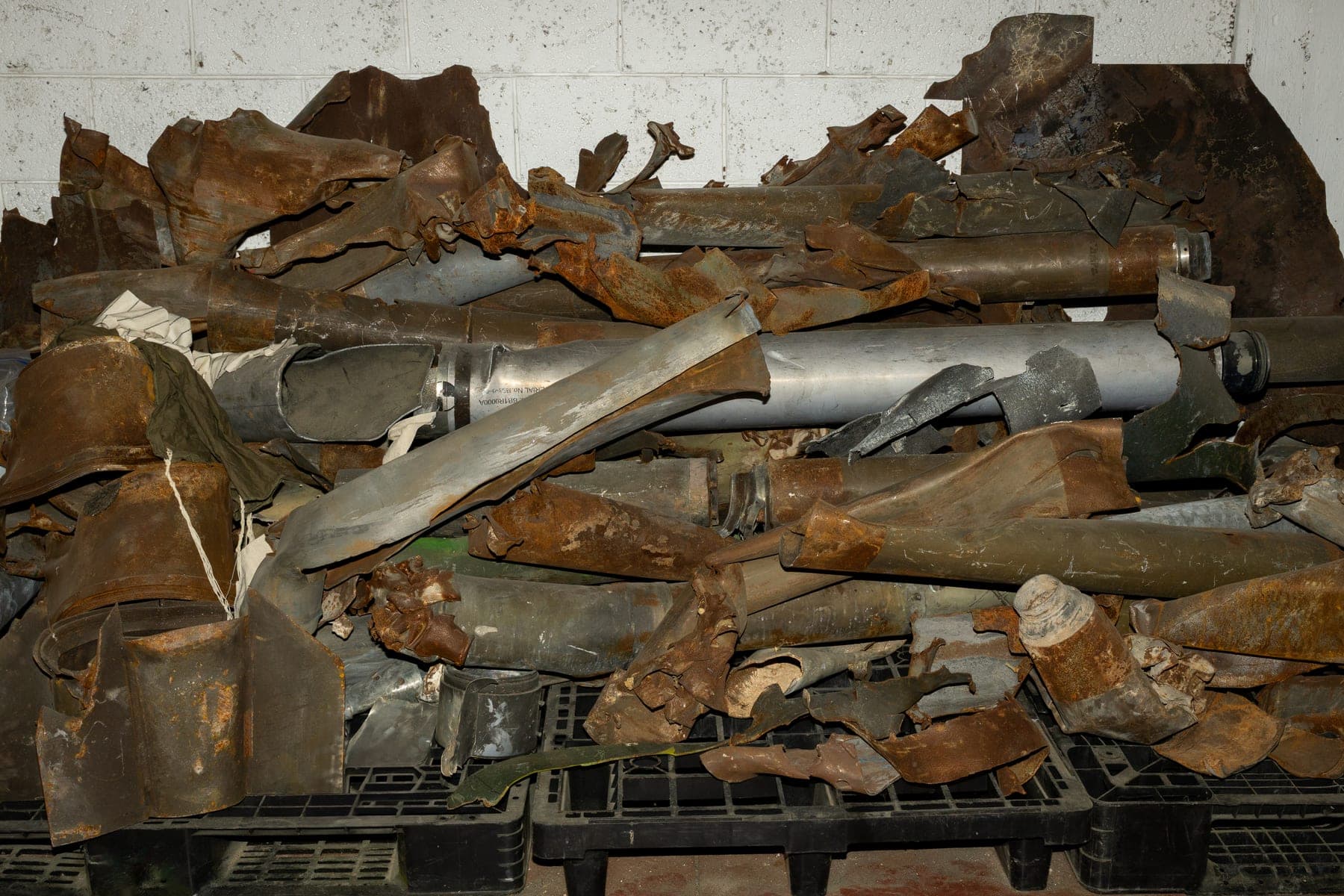
There is a sack in my studio. It stands against the wall, full of metal fragments that mostly look like nothing. A bent edge, a plate blackened by heat, a piece I have no name for. Every few days I take one out, put it on the table, and look at it. Sometimes for half an hour. It is the part of the work nobody sees, and for me it is the main part.
That is what I want to write about here. But first, briefly, how I got to this table.
From Jerusalem to the workbench
I was born in Jerusalem, one of seventeen children in a Hasidic family. In a home like that you learn early that everything has an inside, that even a plain object carries something waiting to be found. Nobody called it art. They called it living.
I loved making things from a young age. I built models and miniatures, and fixed whatever broke around the house. But life took me into tech. Seven years of software testing, some of it in government offices. Good, orderly work. There was no dust in it and no iron.
After October 7th I was called up for reserve duty in a technological unit of the Air Force. The service went on for more than seven hundred days. There, between shifts, I saw missile fragments and Iron Dome interceptor debris up close for the first time, not on a screen. I held one in my hand. I felt it was speaking to me, and instead of putting it aside, I stayed with it. That is how our dialogue began.
A dialogue
Two years have passed since then, with one menorah nearly two meters tall, New York, a studio in south Tel Aviv. But that moment with the fragment in my hand is the foundation of everything I do, so I want to put it into one sentence:
Creation is a dialogue between the maker and the material. The work that emerges is the result of that dialogue. And a successful dialogue produces a work that touches the depths of whoever looks at it.
It sounds simple, but most of the time we do not work that way. We arrive with a plan, and the material is expected to comply. With me it does not work. The fragment on the table already has a shape, a direction, a story. It flew through the air at a speed I cannot picture, exploded, fell, was collected. If I ignore all that and force it to become what I planned, I get an object. A pretty one, maybe, but an object. If I listen first, I get something else.
Listening to material is a very practical thing. It means asking where it wants to bend and where it will break. Which side has to stay as it is, with all its damage, and which side is asking to be polished. I do not polish the damage until it disappears. I leave it visible, because it is half of the conversation. Without that half, the mezuzah is just another mezuzah.
And there is something I learned at home, long before I knew it had anything to do with art: even in the lowest material, even in material made to kill, there is a point hidden inside, waiting for someone to bring it out. The point does not go anywhere. It waits. The work is not to invent it but to find it and give it room.
Why it reaches people
At Hostages Square I watched people stand in front of the menorah for a long time. Some tied a ribbon. Some only stood. They did not look at the explanatory sign, and still they understood. I do not think they understood the "concept." I think they felt that something broken had stayed broken and was nevertheless standing upright and giving light. A whole thing would not have done that to them.
That is exactly what I mean by a successful dialogue. When the conversation between the hand and the iron is honest, the work that comes out of it needs no explanation. It speaks to the person standing in front of it in the same language it spoke to me.
What you will find here
Once a week, on Thursday, I will post an article. Sometimes about one piece and the road it traveled. Sometimes about the material itself and what it teaches. Sometimes about a mezuzah, about the light of Hanukkah, about other artists who worked with wreckage before me. And sometimes simply about what happened in the studio that week.
This will not be a catalog. The pieces are in the shop and in the gallery, and whoever wants them will find them. Here I want to open the door to the room where the conversation takes place, and invite you to sit in it for a moment. And if in the end you choose to take a piece home, you will know exactly which dialogue you are taking with you.
The sack is still standing against the wall. In the next article I will tell you what I found in it.